

This post contains affiliate links. Read my full diclosure HERE.

There are a few ingredients that quietly become part of every skincare conversation—and vitamin C is one of them. It’s recommended for glow, for brightness, for collagen… for almost everything, really.
And yet, somewhere between all those recommendations, something gets lost.
Not all vitamin C is the same.
Not every form works the same way.
And not every approach fits every person, every skin, every lifestyle.
So instead of adding another layer of “you should use vitamin C,” I want to approach this differently—more like a guide than a rulebook. If you understand how it works, and how different forms behave, choosing the right one becomes much simpler… and much more intuitive.
Because skin doesn’t respond to trends. It responds to consistency, nourishment, and the way we support it—both from the outside and from within.
Why Vitamin C Matters for Skin (Beyond the Hype)
Let’s start with what actually matters.
Vitamin C plays a few key roles in the skin, but they all connect to one deeper idea: resilience.
It supports the production of collagen—the protein that gives skin its structure and elasticity. This is why vitamin C is often associated with firmness and that subtle “bounce” we tend to lose over time.
It also acts as an antioxidant, which means it helps the skin navigate everyday stress—sun exposure, pollution, even internal stressors that quietly influence how our skin behaves.
And then there’s brightness. Not the artificial kind, but the kind that comes from more even tone, smoother texture, and skin that reflects light naturally.
But here’s the important part:
Vitamin C doesn’t “fix” skin overnight. It supports processes that take time. Which is why the form you choose—and how you use it—matters more than the idea of using it at all.
♦ READ NEXT: Top 10 Benefits of Collagen Powder for Youthful Skin
Vitamin C for Skin: What You Apply vs What You Absorb
One of the most common misconceptions is that vitamin C works the same way whether you apply it on your skin or take it internally.
It doesn’t.
Topical vitamin C (what you apply)
This works directly on the skin’s surface. It can help with:
- uneven tone
- dullness
- environmental stress
But it’s also delicate. Many forms of topical vitamin C are unstable, meaning they can lose effectiveness quickly if not formulated well.
Internal vitamin C (what you consume)
This works more quietly, but more fundamentally.
When you consume vitamin C—through food or supplements—it supports collagen production from within. It becomes part of the body’s ongoing maintenance system, not just a surface treatment.
It doesn’t give you instant visible results. But over time, it supports how your skin functions, not just how it looks.
And this is where the real shift happens:
Instead of choosing between the two, you begin to see them as complementary.
One refines the surface. The other strengthens the foundation.
Not All Vitamin C Is Equal: Understanding the Forms
This is the part that often gets simplified—but it’s also where your choices start to matter.
When It Comes to Supplements
Most people reach for “vitamin C” without realizing there are several forms, each with a slightly different experience in the body.
Ascorbic acid is the most common. It’s effective, widely available, and affordable—but it can be quite acidic, which doesn’t suit everyone, especially if your digestion is sensitive.
Buffered forms, like sodium ascorbate or calcium ascorbate, are gentler. They’re often better tolerated, though sometimes slightly less potent in immediate effect.
Then there’s liposomal vitamin C LIKE THIS ONE, which is designed for better absorption. It’s encapsulated in a way that helps it pass through the digestive system more efficiently. This makes it a more refined option.
And finally, there are whole-food sources of vitamin C—like camu camu or acerola. These come with additional plant compounds (bioflavonoids) that can support absorption in a more natural, synergistic way. They tend to feel gentler, though the exact dosage can be less precise.
What matters here isn’t choosing the “best” form universally—but choosing the one your body can comfortably and consistently use.

When It Comes to Skincare
Topical vitamin C is a bit more complex—not because it’s difficult, but because it’s sensitive.
The most potent form is L-ascorbic acid. When formulated well, it can be very effective. But it’s also unstable and can be irritating, especially for sensitive skin.
More stable, gentler forms include:
- Magnesium Ascorbyl Phosphate (MAP) – soothing, suitable for sensitive skin
- Sodium Ascorbyl Phosphate (SAP) – stable and often used for acne-prone skin
- Ascorbyl Glucoside – gentle, slower acting, but more stable over time
There’s always a trade-off here:
- potency vs. stability
- speed vs. tolerance
And this is where many people get frustrated—because stronger isn’t always better. Especially if it leads to irritation, inconsistency, or abandoning the product altogether.
♦ FREE DOWNLOAD: The Ultimate Guide to Healthy Skin
How to Choose What Actually Works for You
Instead of trying to optimize everything at once, it’s often more useful to start with your primary intention.
If your focus is visible brightness and more even tone, a well-formulated topical vitamin C can make a difference—especially when used consistently and paired with sun protection.
If your focus is long-term skin health, elasticity, and support, then internal vitamin C becomes more relevant.
If your skin is sensitive, leaning toward gentler derivatives (topical) and buffered or whole-food forms (internal) will likely give you a better experience.
And if your digestion is easily affected, it’s worth paying attention to how your body responds. The “best” supplement is the one you can take regularly without discomfort.
There’s no perfect formula here—only a more aligned one.
Where Things Often Go Wrong
Not because people are doing something wrong—but because the expectations are slightly misplaced.
Vitamin C is often used:
- inconsistently
- in forms that don’t suit the individual
- or with the expectation of quick, visible transformation
But its real strength is cumulative.
It works best when it becomes part of a rhythm—not a quick intervention.
Another common issue is relying entirely on one approach. Using a strong serum while ignoring internal support… or taking supplements without considering topical care.
Skin responds best when it’s supported on multiple levels—but gently.
A More Thoughtful Way to Use Vitamin C
While thinking in terms of products, it can help to think in terms of rituals too.
A simple example:
A warm, vitamin C-rich drink in the morning.
A consistent, well-chosen serum.
A bit of patience.
These aren’t dramatic changes—but over time, they shape how your skin behaves.
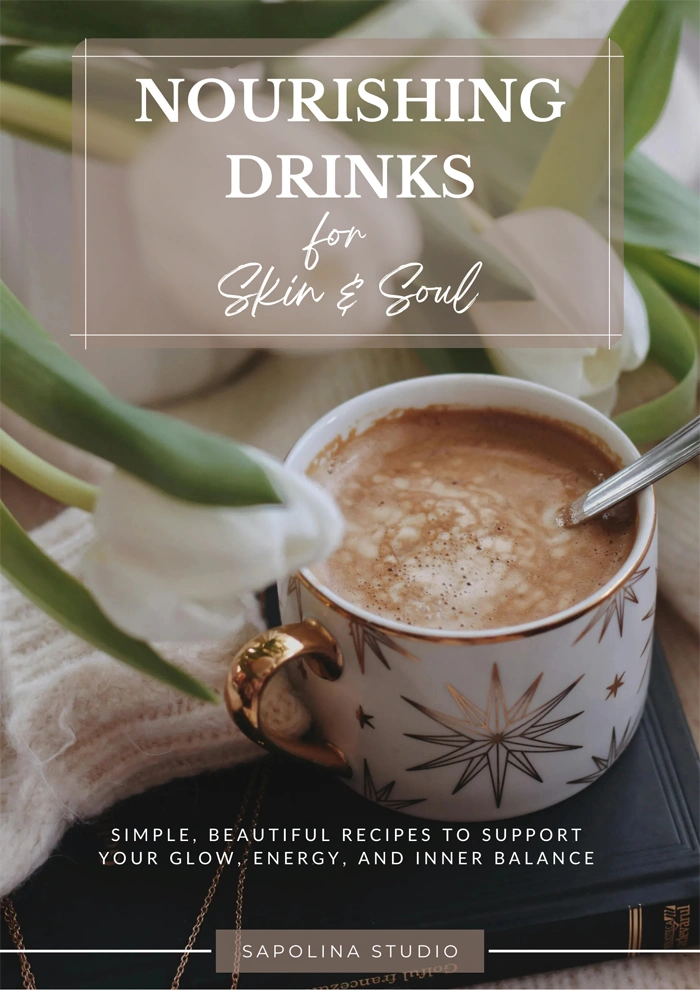
If you’d like to go deeper into this way of caring for your skin, Nourishing Drinks for Skin and Soul was created with that exact intention—bringing together ingredients, rituals, and small moments of care that support both skin and overall wellbeing.
In the End, It’s Not About More—It’s About Better Choices
Vitamin C isn’t magic. But it is meaningful.
Not because it transforms your skin overnight—but because it supports the processes that make healthy, resilient skin possible in the first place.
And when you understand how different forms work, and how your own skin and body respond, you stop following recommendations blindly.
You start choosing—more calmly, more intuitively, and with much better results over time.
That’s where the real shift happens.
Note: Always consult with your medical professional before making any health-related decisions or implementing significant changes to your diet.
Let's connect

Sign Up for news and special offers
+ get our FREE guide!
Thank you!
You have successfully joined our subscriber list.
Check your email!